
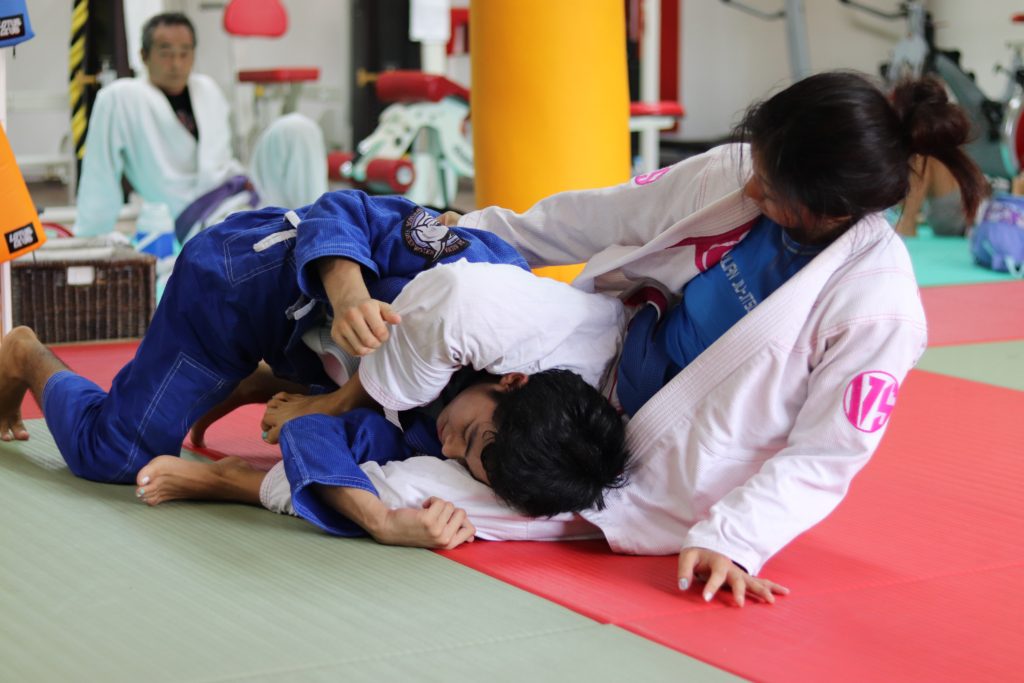
Women’s divisions in IBJJF competition run from Rooster at the lightest end through Light Feather, Feather, Light, Middle, Medium Heavy, Heavy and Super Heavy, plus an open class that anyone can enter regardless of weight.
The men’s brackets and the general federation rules run on the same system — the full IBJJF weight classes chart for gi and no-gi covers those, including the masters age divisions.
The part that catches people out is not the list of names. It is how the weigh-in actually works — and getting that wrong is the most common reason competitors are eliminated before they fight.
You weigh in wearing your gi
This is the single most important thing to understand, and it is where most of the confusion online comes from. The IBJJF rulebook states that an athlete “cannot step on the scale with shoes or any item besides his/her regular uniform and equipment permitted for use during matches.” You step on the scale in the gi you are about to compete in.
A gi weighs somewhere between roughly 1.3kg and 2.5kg depending on the weave, and a heavier competition gi can be the difference between making your division and being eliminated. If you see two different figures quoted online for the same division, this is almost always why: one is the limit with the gi on, the other is someone quoting a body weight.
Weigh your gi at home. Then weigh yourself in it. That is the number that matters.
You get one attempt
The rulebook is explicit: “Each athlete shall only mount the official scale of the event to have his/her weight taken once.” There is no stepping off, stripping down and trying again. If you miss, you are out of your division.
One useful allowance: you may weigh in without knee or elbow braces, though you must be wearing them at gi inspection.
Where to find the exact limits
Weight limits differ between gi and no-gi, and between organisations — IBJJF, ADCC, NAGA and local circuits do not all use the same numbers, and they are revised periodically. Rather than trusting a figure copied from a blog, check two places: You can also run your numbers through the BJJ weight class calculator, which uses the published IBJJF tables and accounts for the gi being on the scale.
- The registration page for the specific event you are entering. Divisions and limits are listed there and are authoritative for that competition.
- The current IBJJF rulebook, published at ibjjf.com, which is the reference the referees and scale actually work from.
This page deliberately does not reproduce a weight table. Limits change, tables go stale, and a competitor who cuts to an out-of-date number and misses weight has been badly served.
Choosing your division
- Compete at the weight you train at. Cutting weight for a hobbyist tournament costs you more in performance than the size advantage returns.
- Account for the gi before deciding. If you are within a kilo of a limit in your gi, you are effectively in the division above.
- Consider the open class as a second bracket rather than a stretch goal. More mat time is usually the point.
- Masters divisions exist from 30 upwards and are split by age as well as weight — often a better field than adult if you are over 35.
Frequently asked questions
Do women weigh in with the gi on for BJJ competitions?
Yes. The IBJJF rulebook specifies that athletes cannot step on the scale with anything other than their regular uniform and permitted equipment, meaning you weigh in wearing the gi you compete in. Gi weight counts towards your division limit.
How many chances do you get to make weight?
One. The rulebook states an athlete shall only mount the official scale once. There is no second attempt if you miss.
What are the women’s BJJ weight divisions called?
Rooster, Light Feather, Feather, Light, Middle, Medium Heavy, Heavy and Super Heavy, plus an open class. The exact weight limits attached to each name vary by organisation and between gi and no-gi, so check the event’s registration page.
Can I compete in the open class as well as my division?
At most events, yes. The open class is separate from your weight division and is usually a second bracket you can enter alongside it.
Are there masters divisions for women?
Yes. Masters divisions run from age 30 upwards and are split by age band as well as weight. For many competitors over 35 the masters bracket is a more even field than the adult division.